1Fresh last date
October 31, 2026 (online). Hard copy to your institution by November 4.
2Renewal
Closed October 15, 2026. The institution must forward it by October 25.
3Who
UP students in UG, PG, diploma, polytechnic, ITI, professional courses and PhD.
4Income limit
SC/ST up to ₹2.5 lakh. General, OBC and minority up to ₹2 lakh (₹2.5 lakh announced).
5eDistrict certificates
Income certificate in your parent’s name; caste (reserved categories); domicile (General, and SC/ST studying outside UP).
What Is the Dashmottar Scholarship?
Dashmottar (दशमोत्तर) literally means “after Class 10”. It is the name Uttar Pradesh uses for its post-matric scholarship and fee reimbursement scheme (दशमोत्तर छात्रवृत्ति एवं शुल्क प्रतिपूर्ति योजना). On the Saksham portal at scholarship.up.gov.in, the important-dates box calls it “दशमोत्तर (11 & 12 के अतिरिक्त)” (Dashmottar other than Class 11-12), and the student login menu lists it as “Postmetric Other than Inter Students”: everything above Class 12.
| Scheme on the portal | Who it is for | Covered on |
|---|---|---|
| Pre-Matric (Purvadasham) | Class 9-10 | UP Scholarship |
| Post-Matric Intermediate | Class 11-12 | UP Scholarship |
| Dashmottar (Postmetric Other than Inter) | UG, PG, diploma, polytechnic, ITI, B.Ed, professional courses, M.Phil/PhD | This page |
Some department reports use “Dashmottar” for everything after Class 10, Class 11-12 included. When you apply, what matters is the portal’s scheme name: if you are in a degree, diploma or ITI course, log in as Postmetric Other than Inter Students. The plain “Postmetric Students” login is for Class 11-12; using it for a degree course runs the wrong eligibility checks and gets the form rejected.
UP students studying in another state are covered too: the SC/ST rules apply to UP residents studying anywhere in India, and the General rules set out the same process for out-of-state students. The portal has a separate “Postmetric Other State Students” login.
Dashmottar is not a single fund. Each category’s money comes from its own department, but everyone applies on the same portal with the same steps:
| Category | Department (as listed on the portal) | Scheme behind it |
|---|---|---|
| SC | Social Welfare (समाज कल्याण) | Post-Matric Scholarship for SC, centrally sponsored: 40% state share, 60% central share |
| General | Social Welfare | State scheme |
| ST | Tribal Development (जनजाति विकास) | Post-Matric Scholarship for ST, centrally sponsored |
| OBC | Backward Classes Welfare (पिछड़ा वर्ग कल्याण) | State scheme (minority backward classes apply under Minority) |
| Minority | Minority Welfare (अल्पसंख्यक कल्याण) | State scheme for Muslim, Christian, Sikh, Buddhist, Jain and Parsi students |
The department decides your rate, verifies your data at district level and makes the payment, which is why the amounts below differ by category.
Dashmottar Scholarship 2026-27 Last Date and Full Timetable
The 2026-27 timetable was issued by Government Order No. 91/2026/1941 of July 20, 2026 (Social Welfare Section-3), for SC, ST, General, OBC and minority students. The same dates appear in the “महत्वपूर्ण तिथियाँ” (important dates) box on scholarship.up.gov.in, which also shows the master-data stages extended to September. We last checked both on October 15, 2026.
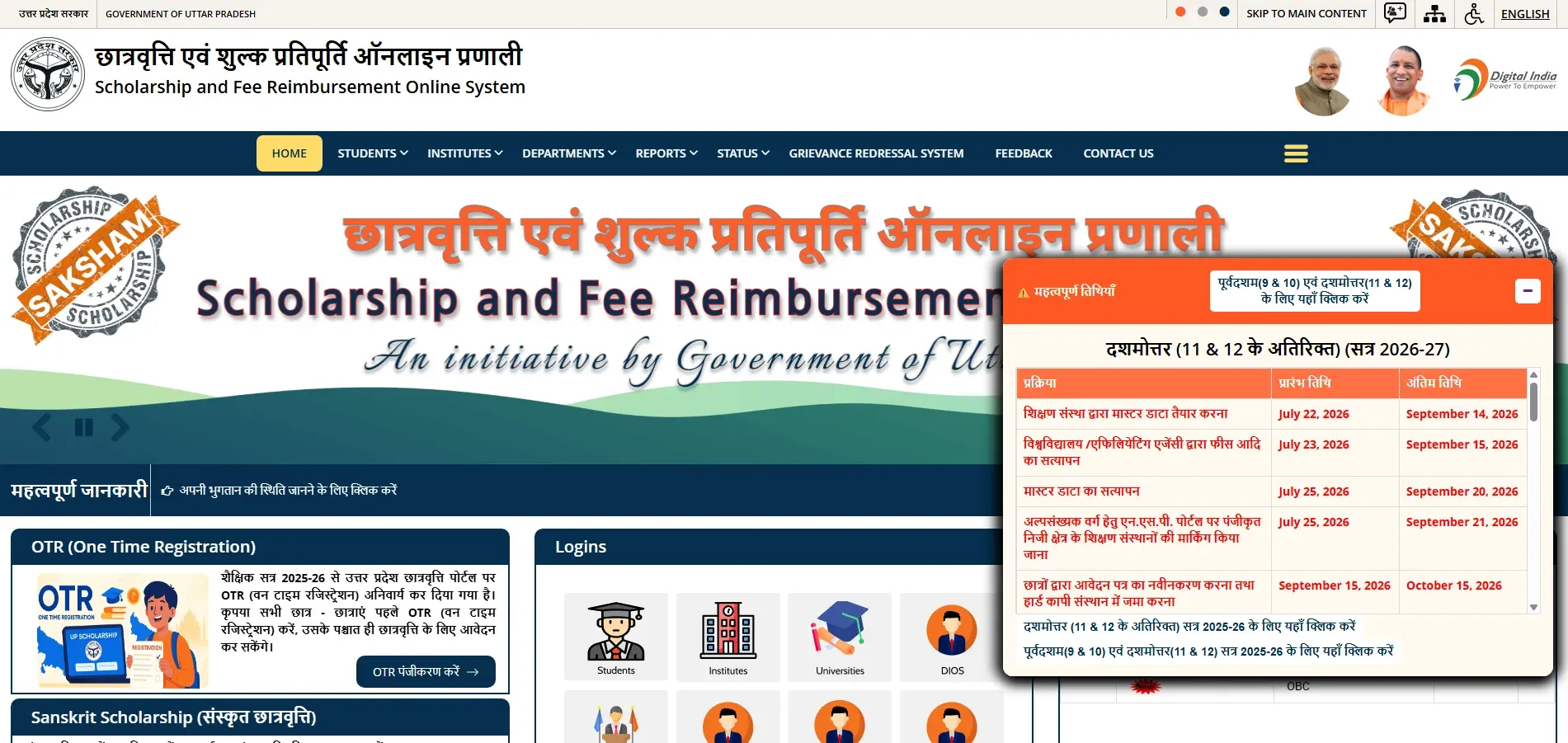
| Stage | Fresh | Renewal |
|---|---|---|
| Institutions prepare master data (courses, seats, fees) | July 22 – September 14, 2026 | July 22 – September 14, 2026 |
| University / affiliating agency verifies fees | July 23 – September 15, 2026 | July 23 – September 15, 2026 |
| Master data verification (District Social Welfare Officer) | July 25 – September 20, 2026 | July 25 – September 20, 2026 |
| Online application | September 15 – October 31, 2026 | September 15 – October 15, 2026 (closed) |
| Take the final print | September 16 – November 2 | — |
| Hard copy + documents to your institution | September 16 – November 4 | September 15 – October 15 |
| Institution verifies, does biometric authentication, enters marks and attendance, forwards | By November 10 | By October 25 |
| University / affiliating agency confirms real students, blocks ineligible ones | By November 25 | By November 5 |
| NIC scrutiny | November 26 – December 5 | November 6 – 20 |
| District committee locks the data | December 6 – 15 | November 21 – 26 |
| First payment round (PFMS) | December 21 – 31 | December 1 – 10 |
| Suspect-data verification and correction | December 6 – 31 | November 21 – December 20 |
| Second payment round (cases cleared after correction) | January 27 – 31, 2027 | January 16 – 25, 2027 |
The order also says:
- A university can verify students and block courses or institutions only after the master data (courses, fees, seats) is locked.
- Your institution forwards a renewal only after your result is declared and you have passed or been promoted with marks; with semesters, both semesters count.
- Universities must upload exam results to the scholarship portal as soon as they are declared, so the marks can be matched.
- An application may not be left pending at any level. If it is held up at the institution, university or district, the nodal officer there is personally responsible.
What happened last year: the 2025-26 Dashmottar window closed on December 20, 2025. Many institutions had not locked their master data in time, so the government reopened the portal twice:
- December 2025: General, OBC and minority students could apply until January 14, 2026; SC/ST students until March 31, 2026.
- September 1, 2026: for 3,16,057 students, with payment scheduled for September 29 – October 2, 2026.
A reopening is a rescue, not a plan. Under the General rules, applications made in an extended window are placed last in the payment order.
Who Can Apply — Dashmottar Eligibility
You can apply if all of these are true:
- You are a permanent resident of Uttar Pradesh (see the certificate rules below).
- You study a recognised course above Class 12, at an institution in the portal’s master data for this year.
- Your family income is within the limit for your category (table below).
- You were admitted transparently: merit list, entrance exam or counselling. Management quota and spot admission seats are not eligible.
- You study in a regular mode. See the correspondence rule below.
- You have at least 75% attendance, recorded by Aadhaar-based biometric or face-recognition attendance.
- For renewal, you passed last year’s exam, or were promoted with marks.
- At a private institution, you are 40 or under on July 1 of the session, unless you are in a research or doctoral course.
- You take only one scholarship or stipend for the course. If you qualify for two, you pick the better one.
Income Limit by Category
| Category | Annual family income up to | Status |
|---|---|---|
| SC, ST | ₹2.5 lakh | In force |
| General, OBC, minority | ₹2 lakh | In force |
| General, OBC, minority | ₹2.5 lakh | Announced by the Chief Minister in the Assembly on February 20, 2026. Check the notice on the portal before relying on it |
“Family income” means your parents’ total yearly income from all sources (your husband’s, for a married woman who is not working), as shown on your income certificate. Other relatives’ income is not counted. If both parents have died, the income of the guardian supporting your studies is taken. All children of the same parents can get the scholarship.
Other Rules That Catch Students Out
These come from the 2023 SC/ST and General rule books on the portal:
-
Two courses per level, at most: at each level (certificate, UG diploma, graduation, PG diploma, PG, research) you can get the scholarship for at most two courses: one professional and one non-professional. You must pass every year.
-
Changing course: if you leave a course after being paid and join another, the first year of the new course is not covered; you become eligible from its second year, with an affidavit. The exception is a student who moves from a non-professional course to a professional one after ranking in an all-India or state entrance exam.
-
Fee paid for the whole course at once: if you paid the estimated fee of the entire course in one go, you are not eligible.
-
Marks for private professional courses:
Course entry level General SC/ST Graduation (e.g. MBA, M.Tech, B.Ed) 55% in graduation 50% in graduation Class 12 (e.g. B.Tech, B.Pharma) 60% in Class 12 No minimum in the rules -
ITI and Class-10-entry courses at private institutes: covered only if you join within 6 years of passing high school.
-
Correspondence and distance courses: excluded under the General and OBC rules. Under the SC/ST rules, they are covered only at central and state universities.
-
Excluded courses (all categories): aircraft maintenance engineering, private pilot licence, Training Ship Dufferin (Rajendra), Sainik School Dehradun training, pre-exam coaching, private courses with no certificate from a university or competent body, and private institutes in UP affiliated only to another state’s university.
-
Stipends and fellowships: PG students who get a government stipend or fellowship are not eligible; MBBS interns get nothing for the internship period.
-
Institution grading: from 2025-26, students are paid only at universities and institutions with NAAC grading (NBA grading for technical courses), and only where Aadhaar-based biometric attendance is in place.
Check your Dashmottar eligibility
Answer seven questions. The checker runs your answers through the income limits, admission rules, renewal rule and amount tables on this page.
A guide based on the rules and rates on this page, not a decision. Your institution, the university and the district welfare officer verify every application.
How Much You Get (Kitna Paisa Milta Hai) — Fee Reimbursement + Allowance
The Dashmottar payment has two parts:
| Part | What it covers | Paid to |
|---|---|---|
| Fee reimbursement (शुल्क प्रतिपूर्ति) | Compulsory non-refundable fees: admission/registration, tuition, exam, sports, union, library, magazine, medical exam and similar fees, as approved | Your bank account by DBT |
| Maintenance allowance (शैक्षणिक / अनुरक्षण भत्ता) | Books, travel and living costs, by course group and by day scholar or hosteller | Your bank account by DBT |
Refundable deposits (security, caution money) and hostel or mess charges are never reimbursed. Students who get free food or free lodging receive one-third of the allowance. Divyang students get 10% extra.
Course Groups
Your amount depends on which of four groups your course falls in:
| Group | Courses (examples) |
|---|---|
| Group 1 | Degree and PG courses in medicine, engineering/technology, architecture, planning, design, agriculture, veterinary, management, computer applications (MBBS, B.Tech, MBA, MCA, B.Sc Agriculture); LLB, LLM; CA, CS, ICWA; M.Phil, PhD |
| Group 2 | Other professional degree, diploma and certificate courses: pharmacy, nursing, M.Ed, paramedical, hotel management, mass communication |
| Group 3 | General graduate degrees: BA, B.Sc, B.Com and other graduation courses not in Groups 1-2 |
| Group 4 | Non-degree courses with Class 10 entry: ITI, 3-year polytechnic diploma (and Class 11-12) |
MA, M.Sc and M.Com: the General rules put them in Group 2; the central SC/ST guidelines put general PG degrees in Group 3.
SC and General Students — Maintenance Allowance
The General scheme’s rate table (annexure to the 2023 rules) matches the rates the SC scheme follows:
| Group | Day scholar (₹/year) | Hosteller (₹/year) |
|---|---|---|
| Group 1 | 7,000 | 13,500 |
| Group 2 | 6,500 | 9,500 |
| Group 3 | 3,000 | 6,000 |
| Group 4 | 2,500 | 4,000 |
Under the General rules, the allowance runs from April 1 or the month of enrolment, whichever is later, until the month your exams end. ST students are paid under the central ST rates; check the rate for your course on the portal.
Fee Reimbursement by Category
| Category | How much of the fee is reimbursed |
|---|---|
| SC, ST | The lowest of: the fee approved by the competent authority, the fee you enter, the fee locked by the university, and the fee locked by the District Social Welfare Officer. No fixed rupee cap |
| General | The approved fee, up to ₹50,000 (Group 1), ₹30,000 (Group 2), ₹20,000 (Group 3) or ₹10,000 (Group 4), whichever is less |
| OBC | The approved fee up to the group ceiling (table below) |
| Minority | As set in the Minority Welfare Department’s rules; check the scheme notice on the portal |
Private institutions that set their own fees: the reimbursement is the lower of the fee charged and the highest fee for the same self-financed course in the state universities (and, for General students, the group cap). Where no authority has fixed the fee, the state universities’ lowest fee for the same regular course is used.
OBC Students — Annual Maximum (Fees + Allowance)
The Backward Classes Welfare Department gives a single yearly maximum per student: a fee reimbursement ceiling plus 12 months of maintenance allowance. The Group 3 (₹20,000) and Group 4 (₹10,000) fee ceilings are set by the 2021 amendment to the OBC rules.
| Group | Fee ceiling (₹) | Maximum, day scholar (₹/year) | Maximum, hosteller (₹/year) |
|---|---|---|---|
| Group 1 (B.Tech, MBBS, MBA…) | 50,000 | 56,600 | 64,400 |
| Group 2 (B.Pharma, nursing, PG non-technical…) | 30,000 | 36,360 | 39,840 |
| Group 3 (BA, B.Sc, B.Com…) | 20,000 | 23,600 | 26,840 |
| Group 4 (ITI, polytechnic) | 10,000 | 12,760 | 14,560 |
If your actual fee is below the ceiling, you get the actual fee. For a Group 1 day scholar, the fee is 88% of the maximum, so the fee rule matters far more than the allowance.
Take the fee ceiling away and the rest is the allowance: ₹550 a month (day scholar) or ₹1,200 (hosteller) in Group 1, ₹530 / ₹820 in Group 2, ₹300 / ₹570 in Group 3 and ₹230 / ₹380 in Group 4. That is the “₹230 to ₹1,200 a month” range other websites quote.
Who Gets Paid First When the Budget Is Short
The money is paid within the budget, in a fixed order. Renewals are paid before fresh applications, and within each, institutions are taken in this order:
- Government and government autonomous institutions
- Government-aided institutions
- Private institutions
| Category | How students are ranked within each group |
|---|---|
| General | By last year’s marks, highest first, down to a 50% minimum; then older students first, then alphabetically, then by application time. Renewals also need 50% marks each year |
| SC/ST | By weightage points: passed high school or intermediate from a government or aided school (10), both parents not literate (8), one parent not literate (6), two SECC-2011 deprivations (4); then older students first |
SC/ST payments come in two instalments: the state’s 40% share first, then the Centre’s 60% share, paid directly by the Government of India to the same Aadhaar-seeded account.
Government, Aided or Private College
- Government and aided colleges: fees are fixed and low, so payments are simple. SC/ST students here get free admission: the institution generates a freeship card from the portal when it forwards the application, and the fee is paid later from the scholarship. Free admission is not available at private institutions.
- Private (self-financed) colleges: the course and fee must be approved and locked in the master data. Admission must be transparent (advertised, rank list, published selection list); this rule was tightened in January 2026 for SC/ST and General students in private technical and vocational courses. If the college charges more than the approved fee, you can lose the fee reimbursement.
eDistrict Certificates — Get These Before You Apply
The Saksham portal does not just take your certificate numbers. It checks them against the eDistrict records and the Revenue Council (राजस्व परिषद) website, and a mismatch stops the form.
| Certificate | Who needs it | Rules for Dashmottar |
|---|---|---|
| Income certificate (आय प्रमाण पत्र) | Everyone | Issued by the Tehsildar or SDM through eDistrict, in your parent’s name, and visible on the Revenue Council website. It must include all income, salary too: leaving out a parent’s salary gets the application rejected. House rent allowance is not counted. For a course longer than one year it is taken once, at admission; a new course needs a new one. Validity is checked on July 1 of the session |
| Caste certificate (जाति प्रमाण पत्र) | SC, ST, OBC | Caste name exactly as in the official list. For SC/ST students studying in UP, the caste certificate shows your residence, so no separate domicile certificate is needed |
| Domicile certificate (निवास प्रमाण पत्र) | General students; SC/ST students studying outside UP; OBC and minority students when the form asks for it | Issued by the SDM of your tehsil, not more than 5 years old on your admission date, and on the Revenue Council website. A UP Family ID is needed first |
Each certificate costs ₹10-15 on eSathi (esathi.up.gov.in) and takes 7-15 working days, or 20-30 days in August-October, when lakhs of students apply at once and the Lekhpal verification queue grows. Each sibling needs a separate income certificate number. Upload the self-declaration form with each eSathi application.
Documents Required and Official Checklist
Keep these ready before you start. The list follows the Social Welfare Directorate’s instructions for students (छात्रों हेतु महत्वपूर्ण निर्देश) and the 2023 rules.
| Document | Who needs it | Notes |
|---|---|---|
| Aadhaar card | Everyone | Name, father’s name, gender and date of birth must match your high school marksheet |
| High school marksheet and certificate | Everyone | The base for your name and date of birth |
| Last exam’s marksheet | Everyone | Marks and full marks are matched with the university’s uploaded result |
| Income certificate | Everyone | Online-issued, in your parent’s name |
| Caste certificate | SC, ST, OBC | Online-issued |
| Domicile certificate | General; SC/ST studying outside UP; others if asked | Online-issued, under 5 years old |
| Fee receipt / fee details | Everyone | The actual annual non-refundable fee, confirmed with your institution |
| University or board registration (enrolment) number | Everyone except first-year students | Needed for every renewal |
| Bank passbook | Everyone | Your own account, Aadhaar-seeded and NPCI-mapped |
| Mobile number and email | Everyone | Your own; one mobile number per application |
Do:
- Make sure your name, father’s name, gender and date of birth on Aadhaar match your high school marksheet exactly.
- Fresh applicants: complete KYC through DigiLocker, which matches your Aadhaar number, name and date of birth. Renewal applicants: Aadhaar demographic authentication plus an OTP on your Aadhaar-linked mobile.
- Use your own email and your own Aadhaar-linked mobile number. One mobile number is valid on one application only.
- Have a bank account seeded with Aadhaar and mapped on NPCI. Keep it active: keep the minimum balance, make a transaction at least every 3 months, and make sure it has no limit on how much money can come in.
- Enter the fee after confirming the actual non-refundable fee with your institution. At private institutions, the course type is always self-financed.
- Fill the form yourself. If someone else (a cyber café or the institution) fills it, watch every entry and check a printout before submitting.
- Check your login 3 days after submitting: errors in your certificate numbers, income or roll numbers are shown there. Fix them (the high school roll number can’t be changed), then take the final print and get a receipt from your institution.
Don’t:
- Don’t give your application to anyone else to hand in. Submit it to the institution yourself and get the receipt.
- Don’t share your Aadhaar number, high school roll number, bank account or password.
- Don’t use another student’s Aadhaar, roll number, bank account or certificates. That gets the application cancelled and leads to penal action against the student and the institution.
- Don’t apply if you failed your exam.
- Don’t wait for the last date. Without the final printout in the institution’s hands, the application doesn’t count.
How to Apply for Dashmottar — Step by Step
These are the official pages on scholarship.up.gov.in for Dashmottar students (they open in a new tab):
Students → New Registration. Do this once.
Login Fresh → Postmetric Other than Inter Students.
Login Renewal → Postmetric Other than Inter Students.
Postmetric Other State Students login.
Check that your college, course and fee are listed.
-
Complete OTR (One Time Registration)
On scholarship.up.gov.in → Students → New Registration (or the “OTR पंजीकरण करें” button on the home page), register once. OTR has been compulsory since the 2025-26 session. If you already have an OTR from an earlier year, use it; don’t create a second one.
-
Choose the right login
Go to Students → Login Fresh (first year) or Students → Login Renewal (later years), then Postmetric Other than Inter Students, log in and choose your category (SC, ST, OBC, General or minority). The wrong login is one of the commonest rejection reasons.
-
Authenticate and fill the form exactly
Fresh: DigiLocker KYC; renewal: Aadhaar authentication with OTP. Then fill in the last exam (board or university, roll number, year, marks), course, year, institution, admission route (merit, lateral entry or entrance exam), day scholar or hosteller, your university registration number, your eDistrict certificate numbers and your Aadhaar-seeded bank account. Lock the form temporarily.
-
Take the final print
The final print becomes available 3 days after you submit. Correct any errors your login shows first. For fresh applications, take the print by November 2.
-
Hand in the hard copy
Sign the print, attach copies of your income, caste and domicile certificates, ID and marksheet, and submit it to your institution’s scholarship desk by November 4 (fresh). Get the receipt that prints with the form, stamped and signed by the institution. You get an SMS when the institution forwards or rejects your application.
Fresh vs renewal: fresh is for the first year of a course. Renewal is for the second and later years of the same course. You log in with the same OTR, and you fill only a few entries: last exam’s marks and full marks, date of admission to the current class, and your university or board registration number. Two rules from the official instructions:
- Not paid in the first year? Still apply for renewal in the next class, not as a fresh student.
- Result not declared yet? Choose “Result Not yet Declared” and apply. Update the result before the suspect-data correction period ends, or the application is treated as rejected.
If you change course (BA to MA), it is a fresh application again.
What Happens After You Submit
- 1
Institution
Level 1 · verify & forward
A committee headed by the principal checks your documents, does biometric authentication, enters marks and attendance, and forwards or rejects.
- 2
University
Level 2 · confirm
Confirms you are a real enrolled student; can block students, courses or whole institutions.
- 3
NIC + district committee
Level 3 · scrutiny
Checks against eDistrict, DigiLocker, board, university and PFMS data; the district committee headed by the DM approves and locks the data.
- 4
PFMS
Level 4 · payment
Money goes by DBT to your Aadhaar-seeded account, in one or two rounds.
The university step is the one most specific to Dashmottar. If your university has not uploaded your enrolment or result, the portal cannot match you, and the application stalls as “suspect data”. Ask your college to chase the university before the November 25 deadline; you can’t fix it yourself.
If your data is flagged as suspect, you must answer the reason, with evidence, online through your institution within the correction period (December 6-31 for fresh applications). If the answer is not uploaded in time, or doesn’t prove your claim, the district committee rejects the application with a digital signature. Our UP Scholarship guide explains the correction window in detail.
Why Dashmottar Applications Fail — And How to Prevent It
1Institution master data not locked
If your college has not locked its courses, seats and fees, students can’t apply or get stuck. This caused both reopenings of the 2025-26 session. Check your college’s courses and fees under Reports → Master Data Report (2026-27) on the portal, and ask the scholarship desk if your course is missing.
2Fee above the approved fee
A private college charging more than the fee locked in the portal can make the fee reimbursement fail. Compare your fee receipt with the fee shown on the portal.
3Management quota or spot admission
Non-transparent admissions are not eligible. Keep your counselling letter, rank card or merit list entry.
4University data not uploaded
Enrolment number or result missing at the university gives a mismatch. Your college must get the university to upload it.
5Aadhaar and marksheet don't match
Name, father’s name, gender or date of birth different on Aadhaar and the high school marksheet stops DigiLocker KYC. Correct Aadhaar first.
6Income certificate problems
Wrong name (not the parent’s), salary left out, a figure typed differently, or a sibling’s certificate number.
7Fail, or attendance below 75%
The institution enters marks and attendance at renewal. A fail or attendance below 75% ends the renewal.
8Hard copy not submitted
Online submission alone is not enough. The signed final print with documents must reach the institution by the deadline.
9Bank account not DBT-ready
Account not in your name, not Aadhaar-seeded and NPCI-mapped, dormant, or with a credit limit. Fix it at your branch before applying.
10Mobile number used twice
A mobile number already used on another application makes your final print invalid. Use your own number.
Private Colleges: Where Most Money Gets Stuck
The September 2026 reopening shows where the problems are. Of the 3,16,057 students whose 2025-26 scholarship had not come:
| Institution type | Students | Share |
|---|---|---|
| Private | 2,46,426 | 78% |
| Government-aided | 37,795 | 12% |
| Government | 31,836 | 10% |
Private institutions carry most of the risk because their fees, seats and admissions need the most checks, because they come last in the payment order, and because the state has had to act against fraud there. In 2023 the Enforcement Directorate searched 22 locations in 6 districts. Private institutions had opened about 3,000 bank accounts in the names of children and older people to draw scholarship money. By October 2023 the alleged amount had passed ₹100 crore, five people, including an institute chairman, had been arrested, and more than ₹6 crore of assets had been attached.
How Big Is Dashmottar? 2025-26 and 2026-27 Figures
Government figures give a sense of the scale (pre- and post-matric are usually reported together; OBC is the only category with a published Dashmottar split):
| Figure | Value | Source |
|---|---|---|
| OBC Dashmottar beneficiaries, 2025-26 | 27,86,431 students, ₹2,882.02 crore | Backward Classes Welfare Directorate |
| … of whom in higher education (UG, PG, diploma, professional) | 19,32,998 (51.8% girls) | Same |
| … of whom Class 11-12 | 8,53,433 | Same |
| Average per OBC Dashmottar student | about ₹10,340 | Our calculation |
| Dashmottar share of all OBC scholarship money, 2025-26 | 93% (₹2,882 of ₹3,102 crore) | Our calculation |
| SC/ST scholarships, last year (all levels) | about ₹2,750 crore to 26.26 lakh students | Chief Minister, October 3, 2026 |
| Minority scholarships, last year (all levels) | ₹360 crore to 5.89 lakh students | Chief Minister, October 3, 2026 |
| UP’s share of the first PMS-SC central release (April 2021) | ₹892.36 crore of ₹4,000 crore (22%), the largest of any state | PIB |
| Payment of October 3, 2026 | ₹148.04 crore to 4,60,559 students: SC 1,59,959, OBC 2,23,615, minority 38,901, General 38,084 | State government |
The state’s target for this year is 70 lakh scholarship beneficiaries across all levels.
Official Rules — Download the Niyamavali
These are the current post-matric rule books (नियमावली) published on scholarship.up.gov.in. Everything on this page about eligibility, fees and the payment order comes from them.
The minority category’s 2023 guideline is listed on the portal, but its link was not working when we checked (October 15, 2026).
When Will the Money Come (Kab Aayegi)? Payment Dates and Status
The 2026-27 order fixes two payment rounds for each group:
| Payment round | Renewal students | Fresh students | Who is paid |
|---|---|---|---|
| First round | December 1 – 10, 2026 | December 21 – 31, 2026 | Applications with clean data, locked by the district committee |
| Second round | January 16 – 25, 2027 | January 27 – 31, 2027 | Applications flagged as suspect data and cleared after correction |
The money goes straight to your Aadhaar-seeded bank account through PFMS. SC/ST students get the state’s 40% share first and the Centre’s 60% share later, so a first credit smaller than expected is normal. Payments also follow the budget order: government institutions first, private ones last.
How to check your status:
-
Application status
Log in through Students → Login Fresh or Login Renewal → Postmetric Other than Inter Students. Your dashboard shows where the application is: with the institution, the university, under scrutiny, locked or rejected. You also get an SMS when the institution forwards or rejects it. The portal’s Status menu lists old sessions only (up to 2024-25 when we checked), so use your login for 2025-26 and 2026-27.
-
Payment status
Use the link “अपनी भुगतान की स्थिति जानने के लिए क्लिक करें” on the portal’s home page, or go to PFMS Know Your Payment directly. Enter your bank and account number and confirm with the OTP.
-
If the payment failed
A status such as “Aadhaar not enabled for DBT” means a bank problem. Go to your branch, get Aadhaar seeded and NPCI-mapped, and the payment is retried in a later round. The full status meanings and PFMS failure reasons are on our UP Scholarship page.
Why the money can be late: your institution forwarded late, the university hasn’t uploaded your result, your data is in the suspect list, your bank account isn’t DBT-ready, or the budget ran out before your place in the payment order. The first three are fixed through your institution; the fourth at your bank.
Helpline and Complaints
If you are stuck, go in this order:
-
Your institution’s scholarship desk: forwarding, fee or master-data problems, the hard copy, the university upload, suspect-data replies.
-
District officer for your category: District Social Welfare Officer (SC, General), District Backward Class Welfare Officer (OBC), District Minority Welfare Officer (minority), District Scheduled Tribes Officer (ST).
-
State department helplines (as listed on the portal’s Contact Us page, 9:30 AM to 6 PM except holidays):
Department For Phone Social Welfare SC and General 0522-3538700 · toll-free 14568 Backward Classes Welfare OBC 0522-2288861 · toll-free 1800-180-5131 Minority Welfare Minority 0522-2286150 · 0522-2286470 Tribal Development ST Contact through the District Scheduled Tribes Officer -
Jansunwai / CM Helpline: jansunwai.up.nic.in or 1076.
Quick Reference
| Detail | Information |
|---|---|
| Login on the portal | Students → Login Fresh / Login Renewal → Postmetric Other than Inter Students |
| Official portal | scholarship.up.gov.in (Saksham) |
| Courses | UG, PG, diploma, polytechnic, ITI, B.Ed, professional, M.Phil/PhD |
| Timetable order | GO No. 91/2026/1941, July 20, 2026 |
| Fresh application 2026-27 | September 15 – October 31, 2026 |
| Fresh hard copy to institution | By November 4, 2026 |
| Renewal 2026-27 | September 15 – October 15, 2026 (closed) |
| First payment round | December 1-10 (renewal), December 21-31 (fresh) |
| Income limit | SC/ST ₹2.5 lakh; General/OBC/minority ₹2 lakh (₹2.5 lakh announced) |
| Maintenance allowance (SC, General) | ₹2,500 – ₹13,500 a year, by group and day scholar/hosteller |
| Fee caps (General) | ₹50,000 / ₹30,000 / ₹20,000 / ₹10,000 by group |
| OBC annual maximum | ₹12,760 (ITI, day scholar) – ₹64,400 (Group 1, hosteller) |
| Attendance | At least 75%, Aadhaar-based biometric |
| Not eligible | Management quota/spot admission, whole-course fee paid at once, fail at renewal, over 40 at a private institution (except research) |
| eDistrict certificates | Income (parent’s name, once per course), caste, domicile (General; SC/ST studying outside UP) |
| Application fee | Free |
| Payment | PFMS DBT to the student’s Aadhaar-seeded, NPCI-mapped account |
| Helplines | Social Welfare 0522-3538700 / 14568 · OBC 1800-180-5131 · Minority 0522-2286150 · CM Helpline 1076 |
Frequently asked questions
What is the Dashmottar scholarship?
Dashmottar (दशमोत्तर, "after Class 10") is Uttar Pradesh's post-matric scholarship and fee reimbursement scheme. On the Saksham portal (scholarship.up.gov.in), "दशमोत्तर (11 & 12 के अतिरिक्त)" means the scheme for courses above Class 12: UG, PG, diploma, polytechnic, ITI, professional courses and PhD. Students log in under "Postmetric Other than Inter Students". Class 11-12 students apply under the separate Post-Matric Intermediate scheme.
What is the last date for the Dashmottar scholarship 2026-27?
Fresh applications: September 15 – October 31, 2026, with the final print by November 2 and the hard copy to your institution by November 4. Renewal applications and hard copies closed on October 15, 2026. These dates are from the Government Order of July 20, 2026 and the portal's important-dates box; check the portal for any extension.
Who is eligible for Dashmottar?
A UP resident in a regular course above Class 12, at an institution listed in the portal's master data. You must have been admitted on merit, entrance or counselling (not management quota or spot admission) and have 75% attendance. Family income must be up to ₹2.5 lakh (SC/ST) or ₹2 lakh (General, OBC, minority). Renewal needs last year's exam passed. At private institutions, students over 40 are not eligible, except research students.
How much money do I get under Dashmottar?
Two parts: fee reimbursement (your compulsory non-refundable fee) and a maintenance allowance. SC and General students get the same allowance: ₹7,000 (day scholar) or ₹13,500 (hosteller) a year in Group 1 courses, down to ₹2,500 / ₹4,000 in Group 4. General students' fees are capped at ₹50,000, ₹30,000, ₹20,000 or ₹10,000 by group. For OBC students the yearly maximum, fees plus allowance, is ₹56,600 / ₹64,400 for Group 1 and ₹23,600 / ₹26,840 for BA, B.Sc and B.Com.
Has the income limit been raised to ₹2.5 lakh for General and OBC?
It has been announced, but we have not seen the order. On February 20, 2026, the Chief Minister told the Assembly the income limit for pre-matric and post-matric scholarships and fee reimbursement was being raised from ₹2 lakh to ₹2.5 lakh. The scheme rules only refer to "the limit set by the state government". Until a notice on scholarship.up.gov.in shows the new figure, treat ₹2 lakh as the limit for General, OBC and minority students.
Can a management quota student get the Dashmottar scholarship?
No. Management quota and spot admission seats are not eligible. In private professional and technical courses, a student admitted directly by the institution without counselling or a national or state entrance exam is treated as management quota. The fee charged must also be the approved fee.
Can distance or correspondence students apply?
The General and OBC rules exclude correspondence and distance courses. Under the SC/ST rules, correspondence students of central and state universities are covered. Courses at private institutions that no university or competent body certifies are not covered.
Do I need a new income certificate every year?
Not for the same course. The SC/ST and General rules take the income certificate once, at admission, for a course longer than one year; a new course needs a new one. It must be issued by the Tehsildar or SDM through eDistrict, be on the Revenue Council website, and show your parents' income from all sources, including salary. Each sibling needs a separate certificate number.
Can I renew Dashmottar if I failed a semester?
No. Renewal needs the previous year's exam passed, or promotion with marks; with semesters, the results of both semesters count. If your result is not out yet, the form has a "Result Not yet Declared" option, but you must update it before the suspect-data correction period ends, or the application is rejected.
I didn't get the money in my first year. Should I apply fresh again?
No. The official student instructions say to apply for renewal in the next class even if you were not paid in the first year. Institutions are told not to accept a continuing student's application as fresh.
Dashmottar scholarship kab aayegi? When will the money come?
Under the 2026-27 Government Order, renewal payments are scheduled for December 1-10, 2026 and fresh payments for December 21-31, 2026. A second round follows in January 2027 (renewal January 16-25, fresh January 27-31) for cases cleared after correction. The money goes by DBT through PFMS to your Aadhaar-seeded bank account. SC/ST students get it in two parts: the state's 40% share, then the Centre's 60%.
How do I check my Dashmottar scholarship status?
For the application, log in at scholarship.up.gov.in through Students → Login Fresh or Login Renewal → Postmetric Other than Inter Students; the dashboard shows the current stage, and you get an SMS when your institution forwards or rejects it. For the money, use the payment-status link on the portal's home page, which opens PFMS "Know Your Payment": enter your bank and account number and confirm with the OTP.
What documents are needed for the Dashmottar scholarship?
Aadhaar; your high school marksheet; last exam's marksheet; an online-issued income certificate in your parent's name; a caste certificate (SC, ST, OBC); a domicile certificate (General, and SC/ST studying outside UP); your fee details; your university registration number (from the second year); and a passbook for your own Aadhaar-seeded bank account. After you submit, attach copies to the signed final print and hand it to your institution.
What is the Dashmottar helpline number?
As listed on the portal: Social Welfare (SC and General) 0522-3538700, toll-free 14568; Backward Classes Welfare (OBC) 0522-2288861, toll-free 1800-180-5131; Minority Welfare 0522-2286150 and 0522-2286470. ST students are handled by the Tribal Development Department. Offices work 9:30 AM to 6 PM except holidays.